SEO-friendly rendering for the customer experience, paired with a lightweight backend for APIs and business logic.
Trade-off: Separate applications add deployment and operational complexity.Case study · 01 India Hidden Gems
From a social audience
to a discoverable travel platform.
Building a practical product, cloud foundation, and delivery system for a growing travel company—without over-engineering the first version.
DISCOVER
THE UNSEEN
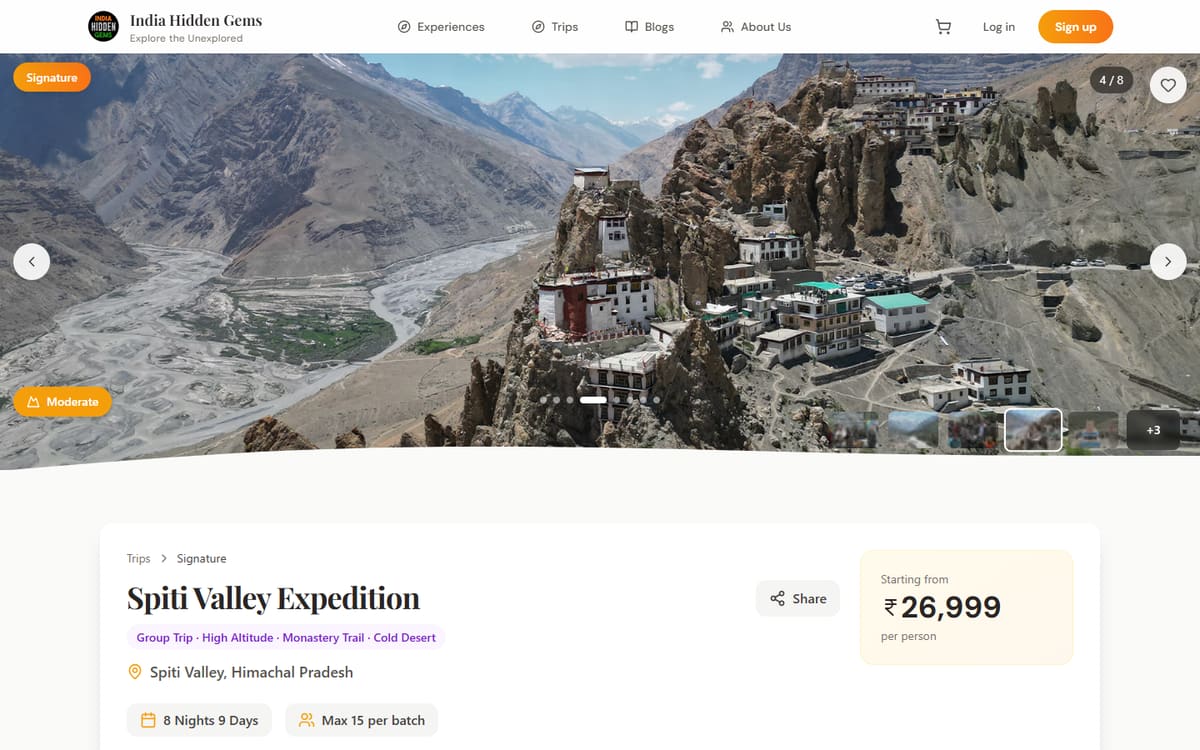
Live on indiahiddengems.com



Company
Content-led travel company founded by Jayesh Waghmare
Role
End-to-end technical implementation
Focus
Product · SEO · Cloud · Infrastructure · Security
Status
Initial platform foundation
The problem 01
A growing business needed more than a social-media home.
India Hidden Gems had already established a substantial social audience: approximately 325K Instagram followers, 130K Facebook followers, and 70K YouTube subscribers. As trips, customers, and operations grew, managing the business primarily through social platforms became increasingly difficult to do systematically.
The goal was a dedicated platform that could support the existing travel business, become discoverable through organic search, and create a practical foundation for future trips, experiences, vendors, creators, and operations.
Constraints 02
Build a first version that was useful now—without closing off responsible future growth.
- Small engineering setup and limited resources
- Existing operations continued during development
- Cost-effective infrastructure was essential
- Development, staging, and production needed isolation
- Credentials could not rely on long-lived keys
- Security and search discoverability mattered from the beginning
The system 03
Next.js→Go API→MongoDB→Cloud Storage
Separate the customer experience from the business logic.
The platform was built as a Next.js customer-facing experience backed by a single Go API, with MongoDB for evolving application data and Google Cloud Storage for media. One API owns every business rule—experiences, trips, handicrafts, editorial content, and a Razorpay-backed cart and checkout—so the frontend stays a view layer, not a second place logic can drift into. Dockerized components behind nginx, and isolated environments, made the path to operation explicit from the start.
Next.jsGoMongoDBFirebase AuthRazorpayGoogle CloudTerraformDockerWIFIAM + ADC
Under the hood 04
One pattern per domain
Catalog (experiences, trips, handicrafts), editorial (blogs, comments, engagement), and commerce (cart, orders, payment, coupons) are each their own package, built to the same five-file shape—model, repository, controller, routes. Adding a feature stays cheap because the shape never changes.
Two identical environments
Staging and production run the same Terraform-defined stack in separate Google Cloud projects: a load balancer in front of an auto-healing instance group, built from a golden VM image, and deployed by a GitHub Actions pipeline that authenticates over Workload Identity Federation—no service-account keys, ever.
Key decisions 05
Define infrastructure as reproducible, version-controlled code rather than manually configured cloud resources.
Trade-off: More initial setup than the cloud console.Use identity-based, short-lived cloud access for people and CI/CD instead of distributing permanent service-account keys.
Trade-off: Careful identity and IAM configuration is required.Treat application security as a development concern rather than a deployment-stage retrofit.
Trade-off: Security controls add development and testing effort.Search & operations 06
SEO as architecture
Search-friendly URLs, Next.js rendering, dynamic metadata, semantic content, canonical handling, sitemaps, robots configuration, image optimization, and internal linking were built into the platform rather than added later.
Repeatable delivery
The operational path uses Git → CI/CD → Docker → Artifact Registry → Workload Identity Federation → Google Cloud. Terraform manages infrastructure, while IAM and ADC provide identity-based access.
Foundation created 07
A platform ready to move beyond social-only operations.
- Search-engine-friendly travel platform
- Automated deployments
- Keyless CI/CD authentication
- Reproducible infrastructure
- Isolated staging and production
- OWASP Top 10-based security practices
Lessons 08
SEO belongs in the architecture.
Build in security with a practical baseline.
Prefer short-lived, identity-based credentials.
Reproducible infrastructure is valuable—even for smaller systems.
Build for today without blocking tomorrow’s product.
Have a similar challenge? 09
Let’s build the
foundation deliberately.
From product architecture to secure cloud delivery, let’s talk about what your system needs to do next.
Start a conversation ↗